

A snapped garage door cable can stop a 150-400 pound door cold, sometimes mid-cycle. If you’re looking at a sagging door, a crooked panel, or a cable that looks more like a frayed shoelace than a steel cord, you’re probably wondering one thing first: how much is this actually going to cost?
Did you know that 1 in 4 garage door repair calls is for a broken cable? Cable failure ranks among the top three most-reported garage door issues nationwide, right alongside broken springs and worn openers. So if your door is acting up, there’s a good chance the cable is the culprit.
In this article, you will learn about garage door cable replacement cost in 2026, broken down by door type, repair scope, and the factors that move your price up or down.
Average Cost of Garage Door Cable Replacement (2026 Data)
Most garage door cable replacements cost between $150 and $350, with a national average of $225 for a standard job that includes parts and labor. That number holds up across several major repair-cost trackers, with the tightest, most common range falling between $150 and $250 for a straightforward two-cable replacement.
Here’s how that average typically breaks down:
| Cost Component | Typical Range |
| Labor | $150 to $200 |
| Cable parts (per pair) | $20 to $50 |
| Standard service call | $80 to $130 (often credited toward the repair) |
| Emergency or same-day service | $250 to $350+ |
| Cable plus spring package | $300 to $600+ |
Garage door cables last 7 to 15 years before they need replacing, so if your home is in that age range and you haven’t had the cables checked, it’s worth a look before one fails on its own.
What Factors Affect Your Final Cable Repair Price
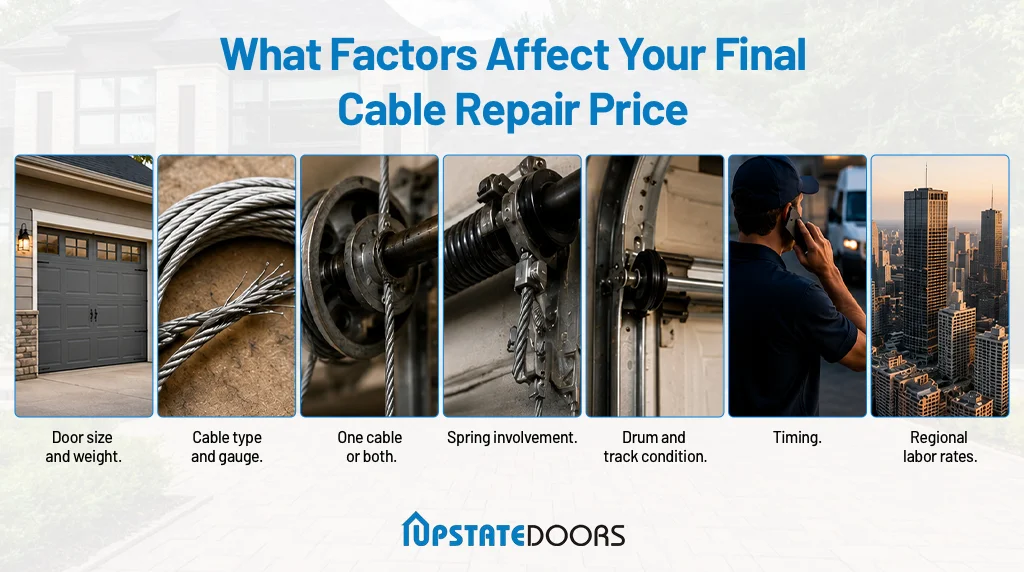
Two homes with the same problem can still get different bills. Here’s what usually drives the difference:
- Door size and weight. A single-car door puts less strain on its cables. A heavy double-car or insulated steel door needs a thicker cable and more work to install.
- Cable type and gauge. Galvanized steel is the standard choice because it resists rust. Aircraft-grade cable is often used on heavier doors or in places with frequent freezing and thawing. Thicker cable costs more but lasts longer under tension.
- One cable or both. Technicians usually replace both cables at once, even if only one broke. Uneven tension throws the door off balance and wears out the other cable faster.
- Spring involvement. Cables and torsion springs share the job of managing the door’s weight. If you have a double torsion spring setup, or if the spring looks worn, your technician may suggest replacing both together instead of just the cable.
- Drum and track condition. If the cable slipped off the drum or bent the track, that adds extra parts and labor on top of the cable repair.
- Timing. Emergency calls after hours or on weekends usually cost $50 to $150 more than a scheduled daytime visit.
- Regional labor rates. Prices can vary 15 to 50 percent depending on the local cost of living and demand for contractors, so a quote in a big city often costs more than the same job in a smaller town.
Single-Car vs. Double-Car Door Cable Cost
Door size has one of the biggest effects on your final number, mostly because of cable length, gauge, and the number of cables involved.
| Door Type | Typical Cable Setup | Average Replacement Cost |
| Single-car (8 to 9 ft wide) | One pair of standard lift cables | $150 to $250 |
| Double-car (16 ft wide) | Heavier-gauge cables, sometimes paired with double torsion springs | $250 to $400+ |
| Double-car insulated or wood door | Reinforced cable and additional hardware adjustment | $350 to $500+ |
Wider doors weigh more, which means the springs carry more tension and the cables have to be rated to match. That’s why a double-car cable job almost always costs more than swapping cables on a single-car door, even when the labor time is similar.
Cable-Only Replacement vs. Spring-and-Cable Package
Not every cable problem needs a full system overhaul, but bundling cable and spring work together is common enough that it’s worth pricing out both options before you commit.
| Cable-Only Replacement | Spring-and-Cable Package | |
| Typical cost | $150 to $350 | $300 to $600+ |
| Best for | Frayed or stretched cables with springs still in good shape | Worn springs plus cable damage, or a system showing imbalance |
| Time on-site | 30 to 60 minutes | 1 to 2 hours |
| Long-term value | Lower upfront cost, but springs may need attention sooner | Resets the whole lift system at once, often with a longer warranty |
If your technician finds that the spring is also near the end of its lifespan, doing both at once usually costs less than paying for two separate service calls down the line.
Signs Your Garage Door Cable Needs to Be Replaced Now
Cables rarely fail without warning. Watch for:
- Visible fraying that looks like loose strands of “hair” along the cable
- Rust or corrosion, especially on galvanized steel cable that’s been exposed to moisture
- A door that hangs crooked or closes unevenly on one side
- Loud popping, snapping, or grinding noises during operation
- The door suddenly felt heavier when opened manually
- Slack or loose cable around the drum that shouldn’t be there
- The door drops suddenly or refuses to open past a few inches
If you notice any of these, it’s worth getting a cable inspected before it snaps completely, since a cable that fails while the door is raised can cause the door to fall and damage the track, panels, or opener on the way down.
DIY vs. Professional Cable Replacement: Is It Ever Safe to DIY?
Garage door cables work under serious tension, and they’re connected to torsion or extension springs that store enough force to cause real injury if mishandled. Here’s how the two options compare.
| DIY Replacement | Professional Replacement | |
| Cost | Materials only, roughly $20 to $50, plus your time | $150 to $350 including labor |
| Time required | 3 to 4 hours for an experienced DIYer | 30 to 90 minutes |
| Tools needed | Winding bars, C-clamps, vice grips, torque wrench | Provided by the technician |
| Risk level | High, due to spring tension and door weight | Low, handled with proper safety equipment |
| Recommended for | Rarely recommended | Nearly all situations |
Most repair professionals and safety guides agree this isn’t a beginner-friendly project. The combination of a heavy door and a wound spring means a mistake can cause the door to fall or the spring to release violently.
If you’re set on understanding the process anyway, our step-by-step cable guide walks through exactly what’s involved, including where most DIY attempts go wrong. For everything else, a licensed garage door repair technician carries the right tools and training to do the job safely in under an hour.
What Happens If You Ignore a Worn or Frayed Cable?
A frayed cable doesn’t fix itself, and waiting almost always raises the eventual cost. Once a cable snaps, the door’s full weight transfers instantly to whatever is still holding it, usually the second cable or the track rollers. That can bend tracks, crack panels, damage the opener motor, or knock the door fully off its rails.
What started as a $150 to $250 cable swap can turn into a $500 to $1,000+ repair once tracks, rollers, or the opener are involved, and in severe cases, a damaged door may not be worth repairing at all, with full door replacement running $700 to $3,500 installed.
Beyond the cost, a cable that fails while the door is open is a genuine safety hazard for anyone standing nearby or driving underneath.
If your cables are showing any warning signs, it’s worth getting ahead of the problem rather than waiting for a failure.
Conclusion
Now you have a clear idea of what garage door cable replacement actually costs. Whatever type of door you have, make sure to hire a professional to replace the cables for safety and long-term durability. Though several factors affect the final price, on average, it will range from $150 to $350 for a standard cable replacement.
However, if you don’t want the hassle of sourcing parts yourself or hunting down a professional to handle your garage door cables, Upstate Doors offers affordable replacement options using durable, trusted-brand cables backed by experienced local technicians.
Get a free cable replacement estimate. Same-day service is available across St. Lawrence County. Request your free quote, and we’ll give you a clear price before any work begins.
Frequently Asked Questions
Can I replace just one garage door cable, or do both need to be done?
Technicians almost always replace both lift cables together, even if only one is damaged. Mismatched cable tension puts the door out of balance and shortens the life of the remaining cable.
How long do garage door cables typically last?
Most cables last 7 to 15 years depending on usage, climate, and exposure to moisture. Galvanized steel cable resists corrosion longer than uncoated cable, but every cable eventually wears out.
What’s the difference between a lift cable and a drum cable?
The lift cable connects the bottom of the garage door to the cable drum mounted on the torsion spring shaft. As the drum rotates, it winds or unwinds the cable to raise and lower the door. “Drum cable” and “lift cable” are often used interchangeably to describe the same part.
Is it ever safe to replace a garage door cable myself?
It’s not recommended. Cables work in tandem with high-tension springs, and releasing or adjusting that tension without the right tools can cause serious injury or sudden door failure. Professional replacement is faster, safer, and often costs less than the price of a trip to the ER.
How do I know if my cable is about to snap?
Look for visible fraying, rust spots, slack around the drum, or a door that closes unevenly. Any grinding or popping noise during operation is also a strong signal that a cable is under unusual stress.
